 PraxiLabs A virtual world of science

Last Updated on June 14, 2026 by Muhamed Elmesery
Understanding the human body requires more than memorizing anatomical structures and physiological processes—it demands exploration, interaction, and hands-on experimentation. That’s where Physiology virtual labs are transforming science education.
By combining immersive 3D simulations with interactive learning experiences, virtual labs allow students to explore body systems, observe biological functions in action, and perform experiments in a safe and engaging digital environment.
In this blog post, we will delve into Physiology virtual lab, its educational impact, subjects that benefit most from virtual labs, the growing demand for virtual labs in universities, advantages of PraxiLabs’ Physiology virtual lab, featured Physiology experiments at PraxiLabs.
Table of Contents
What is a Physiology virtual lab?
Physiology virtual lab is a computer-based, interactive environment that aims to simulate real laboratory experiences and provide a hands-on learning opportunity to:
- Understand various physiological processes and concepts.
- Perform experiments safely.
- Visualize complex biological processes.
- Strengthen practical understanding without the limitations of traditional labs.
These physiology labs simulate human or animal physiology, allowing students to manipulate variables, observe data, and explore several concepts.
Educational Impact of Physiology virtual lab:
According to a study that evaluated the effectiveness of virtual physiology laboratories for student learning (conceptual, motivational, and technical), 11 studies, retrieved from the Education Resources Information Center (ERIC) and Ovid MEDLINE databases, were selected for inclusion in this review, based on predetermined eligibility criteria.
Subsequently, the studies underwent a power analysis for potential biases before their results were synthesized and analyzed. This systematic review found that virtual physiology laboratories are effective for students’ learning of concepts.
The findings of this study suggest that virtual physiology lab simulations are effective for students’ conceptual learning. However, it is inconclusive whether virtual physiology simulations are effective for motivational and technical learning, and further studies required to investigate this.
Physiology subjects that benefit most from virtual labs:
Several physiology subjects benefit greatly from virtual labs because they involve complex body systems, dynamic processes, and experiments that can be difficult to perform in traditional settings. Key subjects include:
- Cardiovascular Physiology — Students can simulate heart function, blood pressure regulation, ECG monitoring, and circulation experiments safely and repeatedly.
- Respiratory Physiology — Virtual labs help learners explore lung volumes, gas exchange, breathing mechanics, and respiratory disorders interactively.
- Neurophysiology — Simulations make it easier to understand nerve impulses, reflexes, synaptic transmission, and brain function through visual models.
- Muscle Physiology — Students can study muscle contraction, fatigue, and neuromuscular responses without specialized lab equipment.
- Renal Physiology — Virtual experiments simplify complex kidney functions such as filtration, osmosis, and fluid balance regulation.
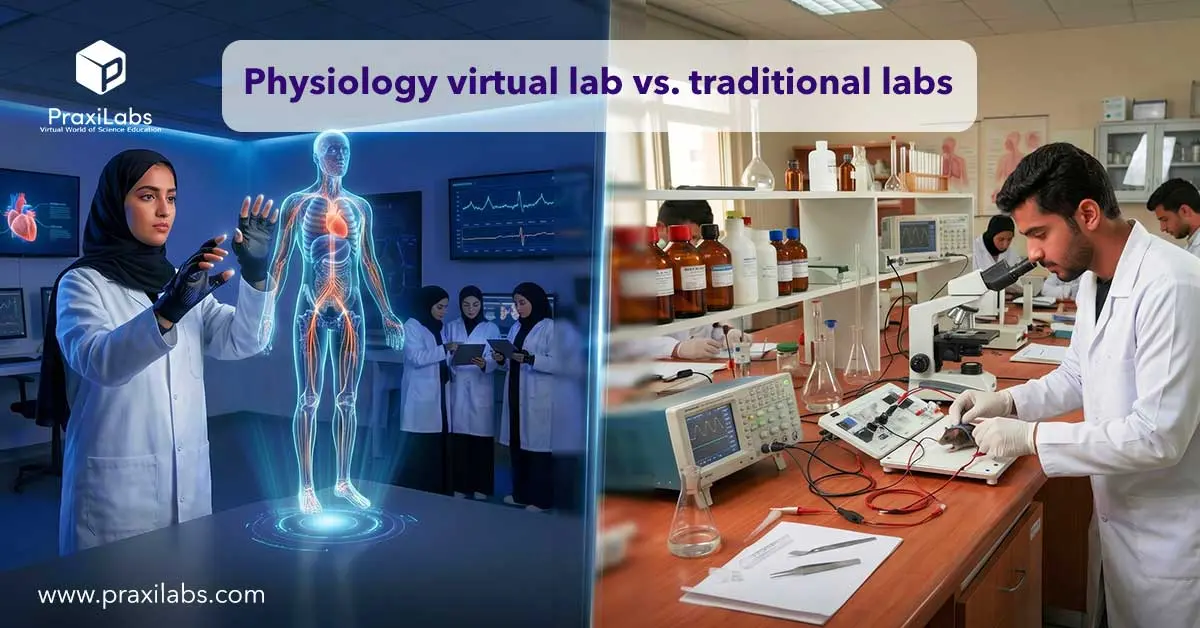
Physiology virtual lab vs. traditional labs:
| Aspect | Physiology Virtual Labs | Traditional Physiology Labs |
| Accessibility | Available anytime and from anywhere with internet access | Requires physical presence in a laboratory |
| Cost | Lower long-term costs, eliminating the need for consumables or expensive equipment | High costs for equipment, maintenance, and lab materials |
| Safety | Completely safe environment with no exposure to biological or chemical hazards | Possible risks from equipment misuse or specimen handling |
| Learning Experience | Interactive simulations with repeatable experiments and instant feedback | Hands-on experience with real instruments and live samples |
| Experiment Repetition | Students can repeat experiments unlimited times | Repetition may be limited by time, cost, or material availability |
| Time Efficiency | Faster setup and experiment completion | Requires preparation, setup, and cleanup time |
| Equipment Availability | No limitations caused by equipment shortages | Limited by the number of available devices and lab stations |
| Data Accuracy | Pre-programmed simulations reduce human error | Results may vary due to manual handling or experimental errors |
| Student Engagement | Uses 3D virtual simulations and gamified learning elements | Encourages direct physical interaction and teamwork |
| Practical Skill Development | Focuses more on conceptual understanding and analysis | Builds real-world technical and laboratory handling skills |
| Scalability | Suitable for large numbers of students simultaneously | Capacity depends on physical lab space and resources |
| Environmental Impact | Reduces waste from chemicals and disposable materials | Generates laboratory waste and consumes physical resources |
The growing demand for virtual labs into universities:
Universities have increasingly turned to e-learning and the use of virtual labs due to the significant benefits they provide for both students and educational institutions, such as:
- Overcoming time and space constraints.
- Providing learners and students in remote areas access to quality education.
- Ensuring educational continuity during crises and emergencies.
- Meeting individual learning needs and diverse methods.
- Supporting self-learning and enabling students to learn at their own pace.
- Using multimedia (videos, animations, interactive simulations) suitable for learning styles.
- Facilitating the hosting of lecturers and experts from around the world to participate in the educational process, enriching the learners’ experience.
- Developing digital skills and preparing for the future.
- Facilitating continuous learning and self-education for anyone wishing to develop their skills or change their career path at any stage of their life.
Advantages of PraxiLabs’ Physiology virtual lab:
As physiology education continues to evolve, virtual laboratories have become essential tools for delivering engaging, accessible, and effective scientific learning experiences.
PraxiLabs enhances physiology education through immersive 3D simulations that allow students to safely perform experiments, visualize complex biological processes, and strengthen practical understanding without the limitations of traditional labs.
By combining interactive technology, flexibility, and curriculum-aligned content, PraxiLabs helps institutions improve STEM learning outcomes while making laboratory education more accessible and cost-efficient.
Our Physiology virtual labs include features such as:
- 3D immersive interaction.
- Anytime, anywhere.
- Personalized & adaptive to learning styles.
- Game-like simulations for students.
- Real-world lab experience.
- Adaptive to learning styles.
- Practice-centric simulations.
- Friendly user experience.
- Bilingual, with simulations language customization (upon request).
- Instant guidance & feedback.
- 24/7 customer support.
- Smooth LMS integration.
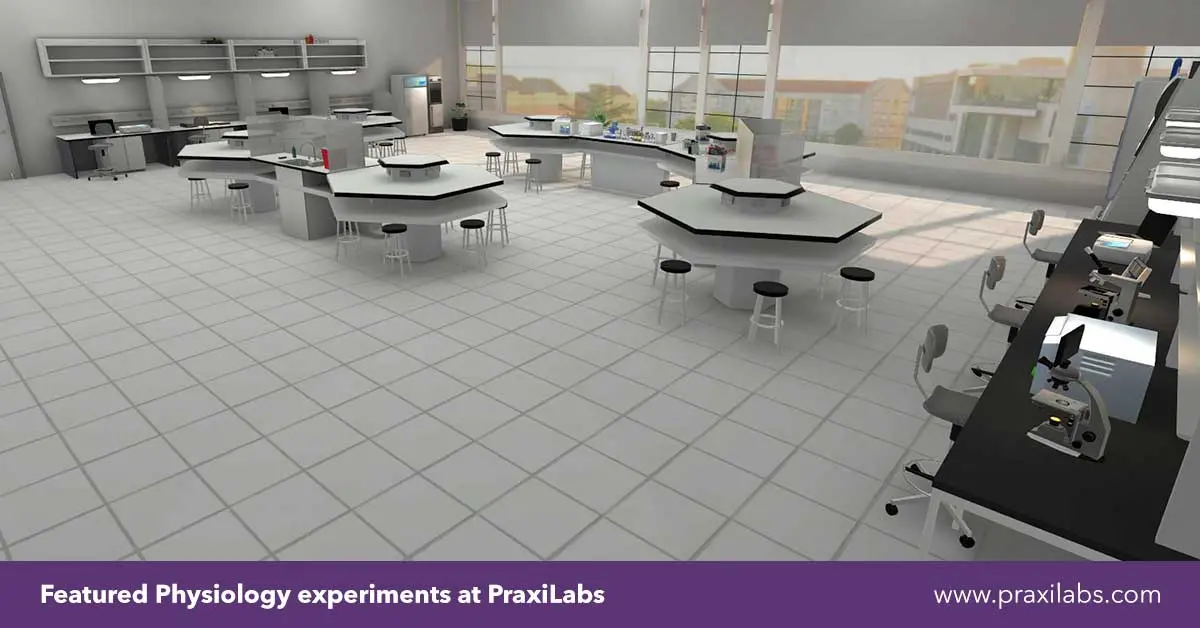
Featured Physiology experiments at PraxiLabs:
Our physiology lab experiments can cover a wide range of topics, including:
Amylase test simulation
By the end of the experiment, your students will be able to:
- Handle the required instruments and consumables in the present experiments.
- Explain how iodine and Benedict’s reagent indicate starch hydrolysis.
- Evaluate the effects of temperature and pH on the rate of enzymatic digestion of starch by amylase.
Explore: Detection of Salivary Amylase Activity (Amylase Test)
Red Blood Cell Count virtual lab
In this experiment you are going to learn how to perform and interpret a manual RBCs Count using the microdilution method. This test is mainly used to diagnose the cause of the high or low count of red blood cells.
Your students will be able to:
- Handle the required instruments and consumables in the present experiments.
- Adjust the hemocytometer and assign the RBCs medium squares and differentiate the squares for counting RBCs from the others under the light microscope.
- How to dilute the blood to enumerate the RBCs using a 40X lens of the light microscope.
- Calculate the total number of RBCs in the diluted blood and multiply it by the dilution factor to calculate the total number of RBCs in one milliliter of the blood.
Explore: Red Blood Cell Count Test-Using Improved Neubauer Hemocytometer
Blood Serum Extraction simulation
In this experiment, you will learn how to perform a blood serum extraction and interpret the results. This test is primarily used for separating serum from a blood sample.
Let your students:
- Understand safety precautions when handling blood.
- Recognize different blood collection tubes.
- Perform centrifugation.
- Understand methods and techniques for separating serum from blood samples.
Explore: Separation of Serum from Blood by Centrifugation
Frequently Asked Questions
What do you do in a physiology lab?
In a physiology lab, you can understand and visualize complex biological processes. Also, you can perform experiments such as blood serum extraction and red blood cell count.
Are virtual labs safe for students?
Yes! virtual labs are safe for students, these labs enable learners to conduct their experiment in a safe environment away from any risks such as chemicals, electricity, radioactive substances.